
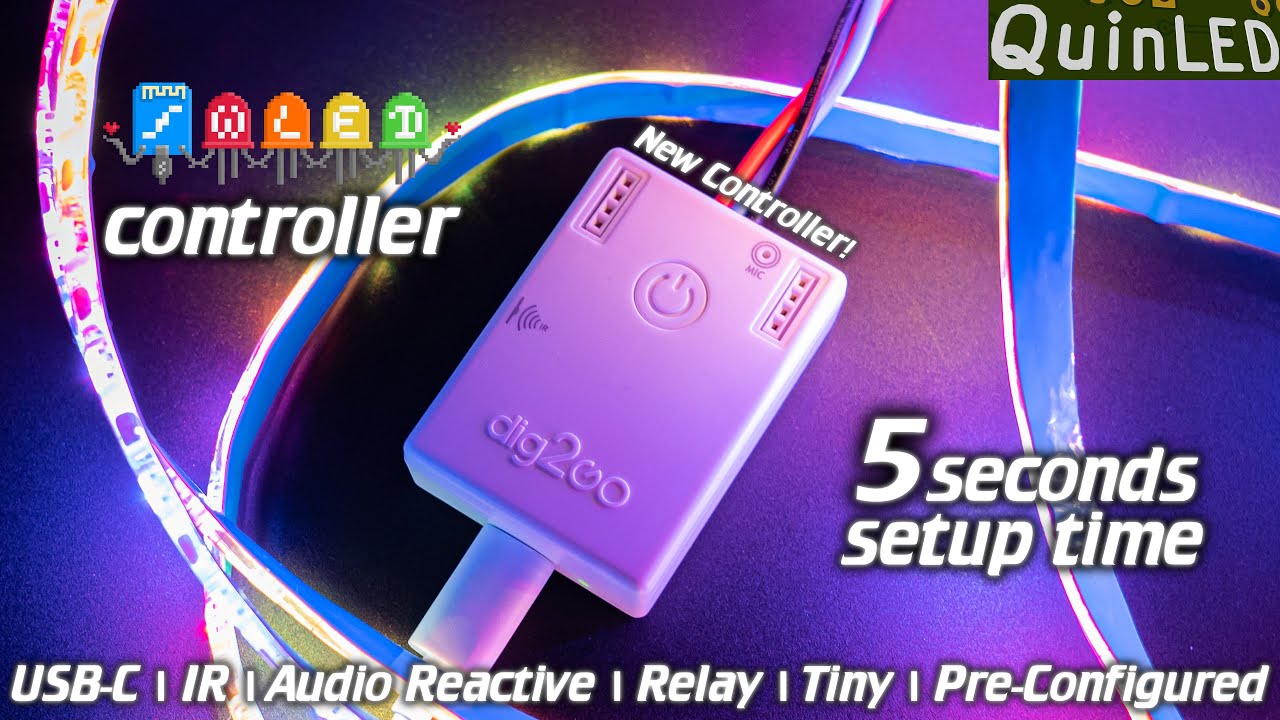
dig2go is a tiny USB-C controller that runs WLED out of the box. Plug in power, clip on a strip, and you're running colour from your phone in minutes. No soldering, no fuss.
Everything a first addressable-LED project needs is already on the board, in a box small enough to forget about.

It arrives running WLED: control it from your phone over Wi-Fi, with hundreds of effects and no code. It's your hardware too, so reflash it for ESPHome, FastLED or Moonlight whenever you like.
It comes in a finished case with the connector for your strip already included, and nothing to solder. Just plug it in and you're done.
Runs from a simple phone charger or power bank: 5V, up to 15 W. A built-in MOSFET "relay" even cuts power to the strip when the lights are off, so there's no idle drain. Great for battery projects.
A high-quality digital microphone is built in for WLED's sound-reactive effects. There's an IR receiver too, so a cheap little remote changes colours from the couch. No phone needed.
Just 41 by 57 by 17 mm in a finished, screwless case. It tucks behind a monitor, under a shelf or behind the TV and simply disappears.

Designed and refined by QuinLED, with years of experience building LED controllers, and trusted in thousands of home builds. Real engineering, not a rebadged board off a marketplace.

Built by QuinLED, the same people whose controllers run in thousands of serious LED builds.
Beginner-simple to use, properly engineered underneath. Here's exactly what's on the board.

| Processor | ESP32 dual-core 240 MHz · 4 MB flash · CH340 USB-serial |
| Firmware | WLED pre-installed · also runs ESPHome, FastLED, Moonlight |
| Power in | USB-C · 5V / 3A · up to 15 W |
| LED output | 1× level-shifted 5V data · onboard MOSFET "relay" cuts strip power when off |
| LED support | WS2812B · SK6812 (RGB & RGBW) · WS2811 · bullet & seed pixels |
| Capacity | ~300 LEDs (about 5 m at 60/m, power-budget dependent) |
| Audio | Built-in high-quality digital microphone |
| Control | IR receiver · on/off button · Wi-Fi (2.4 GHz, AP + home) |
| Expansion | 2× 4-pin headers · switched 5V, 3.3V, 2× GND, 4× GPIO (I²C) |
| Protection | Separate protection circuits · self-resetting fuses |
| Case | Custom molded · screwless · 41 × 57 × 17 mm |
Full pinout and specs live in the QuinLED documentation.
If you can plug in a phone charger, you can set up and control these LEDs too. Four steps from box to glow.
Plug a USB-C cable into the dig2go and a simple phone charger or power bank. A small green light means it's awake.
Click your addressable strip onto the included pigtail. It lights up a gentle orange the moment there's power.
On your phone, connect to the dig2go's own Wi-Fi, then add it to your home network. It takes about a minute.
Open the free WLED app, pick a colour or an effect, and you're done. Tweak it whenever the mood changes.

Brand new to addressable LEDs? Start with the guide. It walks you from an unopened box to colour on the wall. Got a specific question? The FAQ has plain answers to the things people ask most.
A little dig2go and one strip of addressable LEDs go a long way. Here's the kind of glow you can expect, one project at a time. Click any scene to enlarge.
Quindor walks through the dig2go: what it is, and how quickly it gets you lit.
Not sure what to buy? That's the whole point of a bundle: the controller, the power and the right strip arrive together, ready to plug in. New to this? The RGBW 5 m kit is the one most people are happiest with.
Do you already own a 5V addressable LED strip?
Got a spare 5V/3A USB-C charger lying around?
What's the plan?
Our pick for you:
Only at Allnet (worldwide)
Prices are indicative in USD and vary by region and store, so check the shop for the exact amount. Every kit arrives ready to plug in. The bullet-pixel kit is stocked by Allnet (worldwide) only.


